Aprons
MAKU. Apron
幕 エプロン$130.00In stock
Experience the enduring quality and the artisan's spirit that live on in Kyoto. Each piece is made with care, to be kept for a lifetime.
For more than seventy years in Kyoto, the long-established Kato Ken Flag Shop has made flags and noren (the split fabric curtain hung in a shop doorway). Drawing on the genuine materials, methods and skills gathered over those years, we have begun a new brand, “kiten.” Working with the sturdy cloth that serves professional trades and the character of hand-dyeing, we propose aprons and other goods that make daily life a little easier and lift the spirits. Please enjoy a feel that lasts a lifetime, in which the artisan's heart of Kyoto lives on.
For more than seventy years in Kyoto, the long-established Kato Ken Flag Shop has made flags and noren (the split fabric curtain hung in a shop doorway). Drawing on the genuine materials, methods and skills gathered over those years, we have begun a new brand, “kiten.” Working with the sturdy cloth that serves professional trades and the character of hand-dyeing, we propose aprons and other goods that make daily life a little easier and lift the spirits. Please enjoy a feel that lasts a lifetime, in which the artisan's heart of Kyoto lives on.
Into the name “kiten.” we placed two thoughts. One is the ki and the ten of yorisou, to keep close company — to stand at the customer's side and lend support. The other is kiten, a starting point — to encourage the small beginnings within a life. In Japan, for close to a thousand years, flags have been raised as marks of pride and belonging. For seventy-five of those years this workshop has dyed flags for temples and shrines, for festivals, and for film and television that ask for fidelity to their period. The cloth we dye for the sumo keshō-mawashi (the embroidered ceremonial apron worn in the ring-entering rite) now takes the form of an apron.
What we offer through kiten. is no shortcut, but our craft itself, thought through again for the kitchen, the workplace, the daily commute. The depth and character particular to a long-established Kyoto workshop, finished with the same care we have long poured into flags.
Everything this workshop makes has its origin in three ceremonial cloths. Every garment begins in the same way: with a conversation — for whom is it made, and what is it to convey — and each, in time, arrives somewhere different. One comes to rest atop a single pole, one at a doorway hung with noren, and one upon someone's two shoulders.
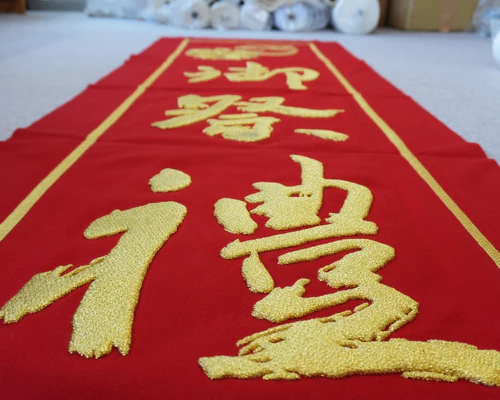
Flags that stand as the emblem of a body of people: we have given form to what was hoped for, discussing everything from the colour of the thread to the manner of the weave. Within them are gathered the techniques of Nishijin weaving, of embroidery and of dyeing. We hold to working alongside true artisans, so as to realise more than the customer had pictured.
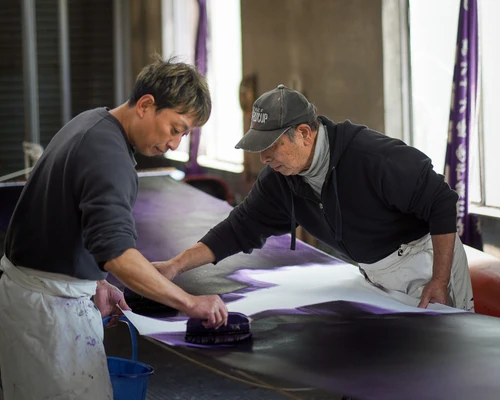
Using shirushi-zome, a dyeing technique developed to render family crests beautifully, we make noren that serve as a customer's own symbol. Since the most suitable cloth and method of dyeing differ with the setting in which a noren will hang and with its design, we work in concert with artisans of fine hand in each technique.
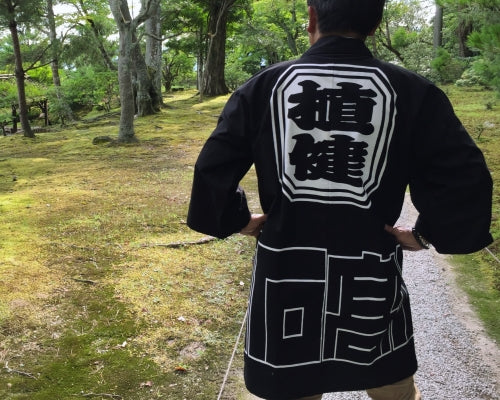
The happi — the short coat worn by artisans and at festivals — is a garment worn upon the body, so we choose the cloth best suited to the season and the occasion, and make it by traditional dyeing techniques so that its particular character may be expressed.
A Kyoto workshop, through three generations.
The family had long kept a shop making mizuame, the rice syrup used in wagashi (traditional Japanese confections), but the Pacific War left the rice it required desperately scarce. Obliged to give up its equipment as well, the family trade was brought to a close. Afterward Kato Kenzō, who had entered the household as an adopted son-in-law, resolved to raise it up again as a flag shop, drawing on the dyeing skills cultivated by the house of his birth.
Founded by Kato Kenzō, the first generation, as “Kato Ken Flag Shop.” Drawing a line beneath a history of making confectionery ingredients, he honed the techniques of dyeing and of noren making, and set out as a flag shop rooted in its own quarter of the city.
Kato Takashi, the second generation, took up weaving techniques in earnest, Nishijin weaving foremost among them. In this way he established the means to produce highly accomplished made-to-order work, joining weaving of quiet luxury to traditional dyeing.
Today everything is made entirely to order: flags and noren for ceremonies and festivals, curtains for temples and shrines, shrine nobori, happi, and even sumo keshō-mawashi and championship banners. The number made now exceeds fifty thousand, and the sure command of period detail and technique has brought a wide range of commissions for the art departments of film and television, made to suit each setting.
Kato Tsuyoshi, the third generation, has begun the new brand “kiten.” Carrying the materials, methods and designs cultivated over long years of flag-making into contemporary life, he proposes useful pieces that keep close company with the days as they pass, and continues to seek new value in traditional craft.